The Buffalo — the Mzinyathi — was the line between the Colony of Natal and the Zulu Kingdom. Rorke’s Drift was a crossing on it. Isandlwana lay just beyond the far bank. And in 1873, the farmers and traders scattered across that remote north-eastern corner raised their own mounted corps to watch it: the Buffalo Border Guard.
Never more than about thirty men on the roll. Six years later they rode into the Anglo-Zulu War.
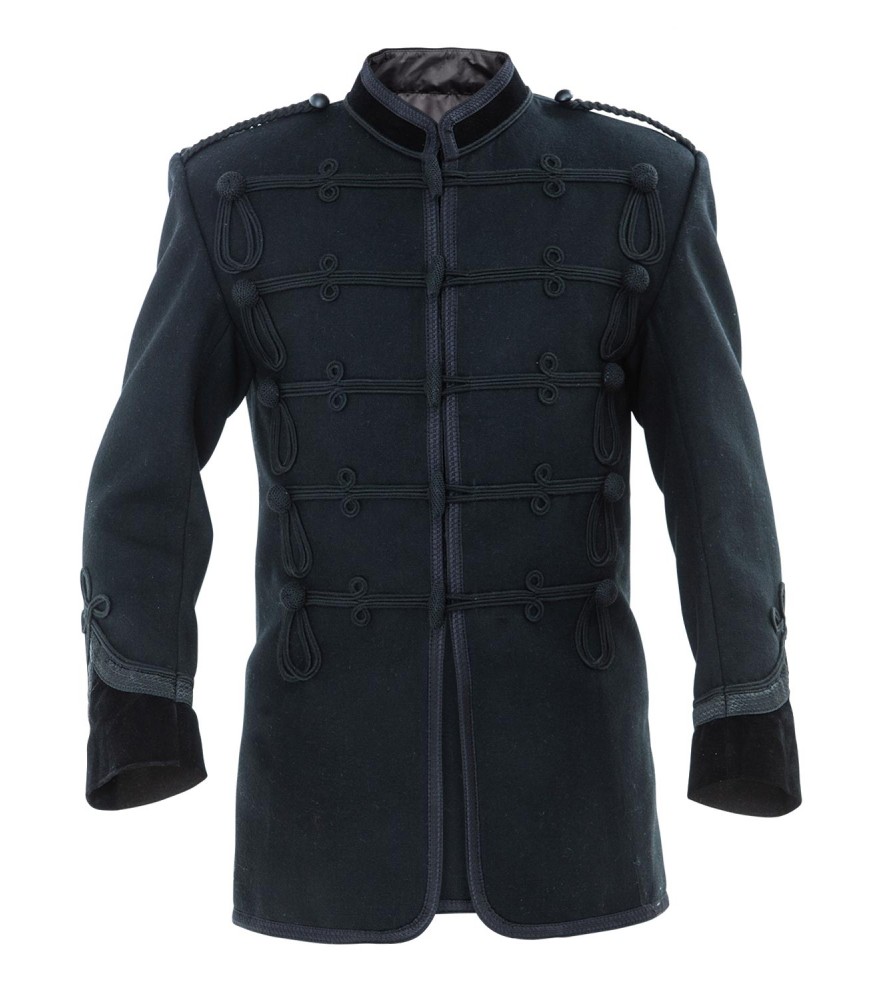
This is a faithful reproduction of the patrol jacket they wore — the undress order a colonial volunteer actually lived in. Not parade scarlet. Working black.
Built the way the original was built
The body is cut from black melton wool, densely milled and close-woven, the cloth that made Victorian military tailoring hold its shape through a season in the field. It has weight. It hangs.
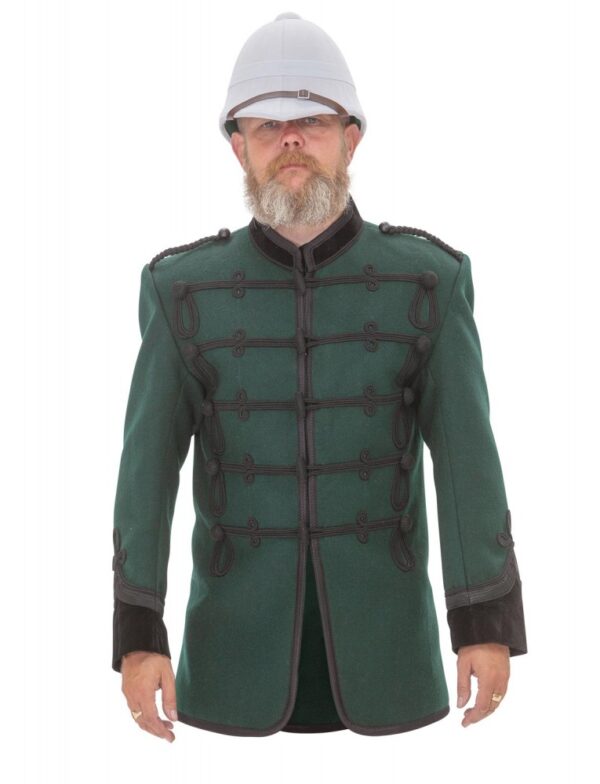
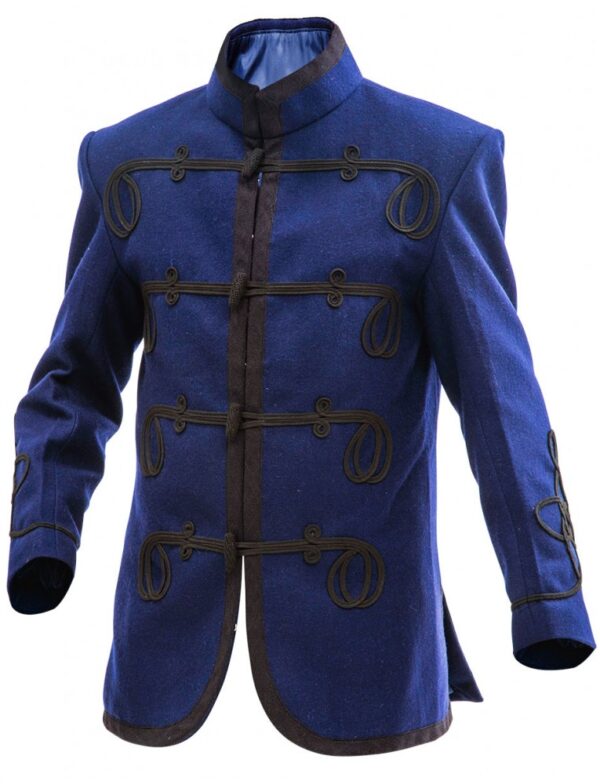
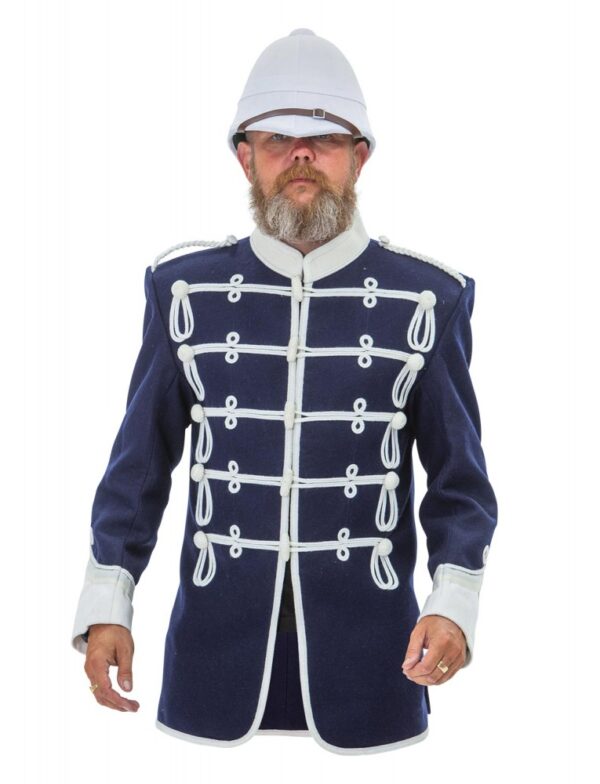
Across the chest run five rows of black braid frogging, each terminating in a hand-formed trefoil loop and closing over an olivet button. The front fastens with concealed hooks and eyes behind the braid, so the line of the jacket stays unbroken — the detail that separates a real patrol jacket from a costume.
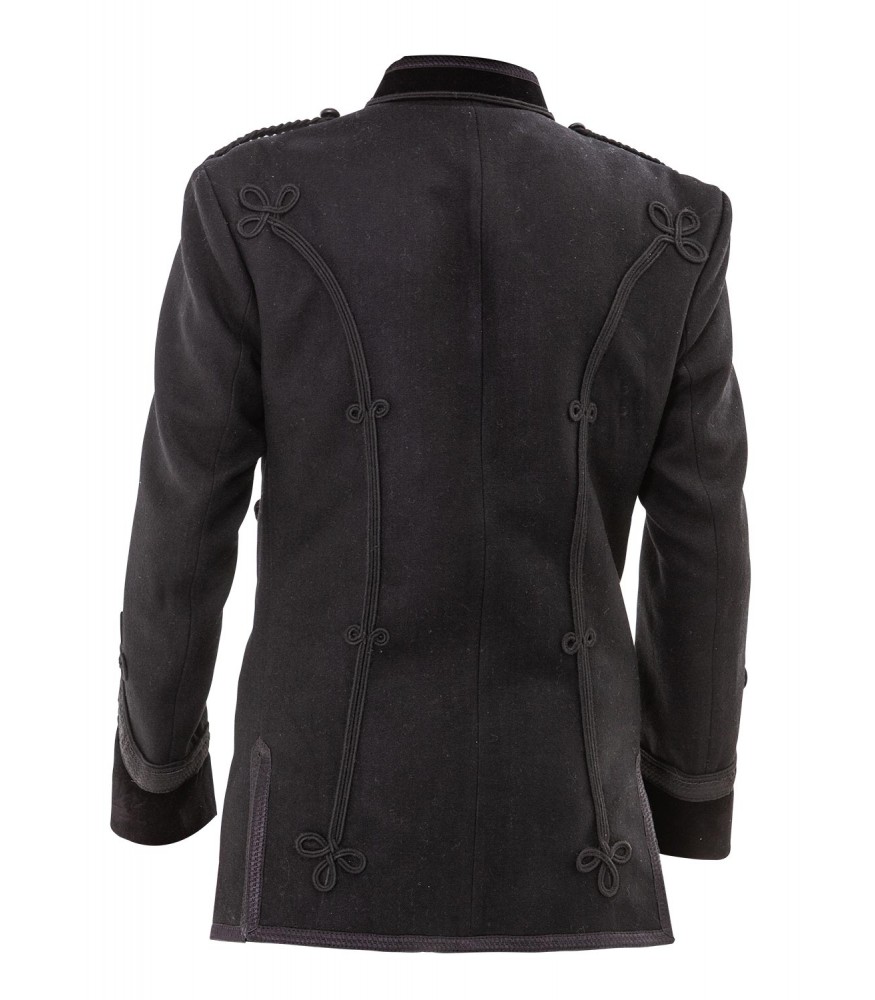
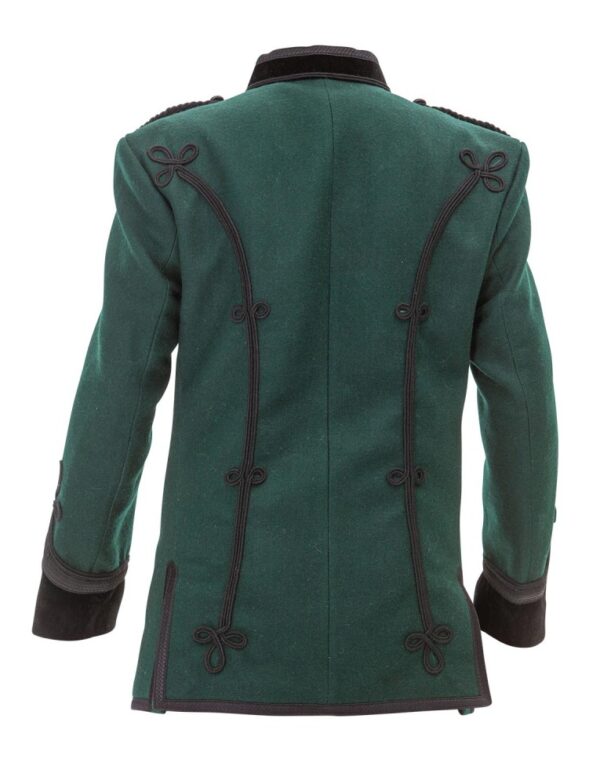
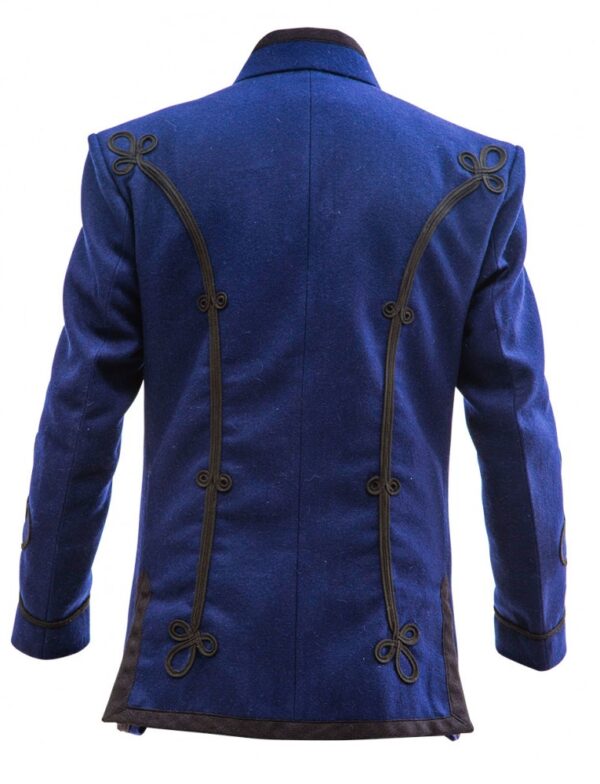
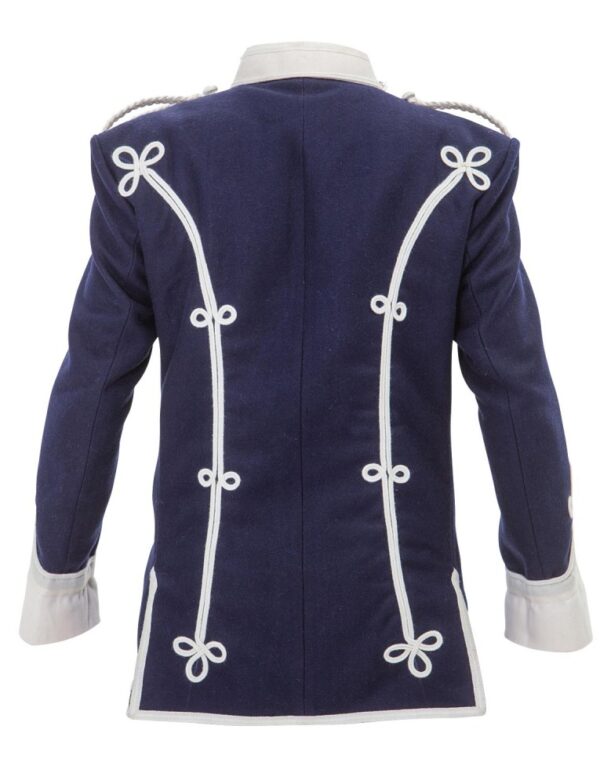
The high stand collar is faced in black velvet and edged in trim. The pointed cuffs are velvet-faced and finished with a hand-worked Austrian knot, the looped braid ornament carried down from the hussar dolman into every British undress jacket of the period. Braid continues across the back seams. Braided shoulder cords sit at each shoulder, secured with a small button.
Fully lined throughout — for the drape and the wear, not the look.
The whole thing is black on black. All texture, no colour. Which is precisely why it works as well over jeans on a Friday night as it does at a battlefield commemoration.
Who buys this
Anglo-Zulu War reenactors and living history groups who need an accurate colonial volunteer impression rather than a regular-army tunic.
Militaria collectors who want the pattern on a stand without paying five figures for a surviving original — and there are very few originals from a unit this small.
Film, television and theatre wardrobe working Victorian southern Africa.
Hussar, steampunk and dark alternative wardrobes — this is the real garment the look was borrowed from, in wool, made to your measurements.
What you’re buying
Reproduction, made to order to your measurements. Not an antique original.
Black melton wool body with full lining
High stand collar, black velvet faced with trim
Pointed black velvet cuffs with hand-worked Austrian knot braid
Five rows of black braid frogging with olivet buttons across the chest
Braid detail continued across the back
Braided shoulder cords
Concealed hook-and-eye front closure
Hand-applied braid — every knot laid by hand, not machine-tacked
Lead time
Each jacket is cut and braided to order. Current lead time is 2 weeks from the date measurements are received. Because it is made to your specification, it is excluded from standard change-of-mind returns — faults and defects are covered in full under our returns policy.
$239.99Original price was: $239.99.$191.99Current price is: $191.99.
Your MeasurementsEnter your measurements carefully for the best possible fit.Customize Your OrderChoose the construction details and matching add-ons you prefer.Additional RequirementsAdd any special instructions or delivery requirements for your order.Your OrderReview and Add to CartLive TotalSelected OptionsFinal TotalFinal price updates with your selections.Secure Checkoute.g. 5'10"e.g. 178Measurement unitinchesHow to measurethis optionMeasurement guideLeave these and we cut them to standard proportions.andMeasuring guideGot itClose guideWaistHow to measure your waistA kilt sits at the navel, not at the hipTrousers sit several inches lower. Measuring where your jeans sit gives a waist that is too small, and the kilt will ride down.Measuring the natural waist at the navel for a kiltStand relaxed and breathe normally. Do not hold your breath or pull the tape tight.Bring the tape around your natural waist, level with your navel.Keep the tape horizontal all the way round and snug against the body.Read the measurement in inches and round to the nearest whole number.Kilt lengthHow to measure your kilt lengthThis is not a waist to floor measurementA kilt finishes at the middle of the knee. Measuring to the floor, or to the top of the knee, is the most common ordering error we see.Measuring kilt length from the navel to the middle of the kneeStand up straight with your feet slightly apart, wearing flat shoes or none.Start at your navel, the same point you measured your waist from.Measure straight down to the middle of your kneecap.Ask someone to help if you can. Bending to read the tape shortens the result.HipsHow to measure your hipsWe need this oneThe pleats are shaped to your hip measurement, so we cannot cut without it. A hip figure smaller than your waist is worth double-checking before you order.Measuring around the fullest part of the seatStand with your feet together and your weight even on both legs.Measure around the fullest part of your seat, usually about 8 in below the waist.Keep the tape level front and back, resting on the body without compressing it.ChestHow to measure your chestDo not add room yourselfCustomers often add two inches for comfort. The pattern already includes it, so the jacket comes back too large.Wear the shirt you will wear under the jacket.Measure around the fullest part of the chest, under the arms and across the shoulder blades.Keep the tape level and snug, with your arms relaxed at your sides.Do not add anything for comfort. We add the fitting ease.WaistHow to measure your jacket waistThis is not your kilt waistA kilt is measured at the navel. A jacket waist is taken higher, at the narrowest point of the torso, and is usually an inch or two smaller. Reusing your kilt waist gives a jacket that is loose through the body.Wear the shirt you will wear under the jacket.Measure around the narrowest part of your torso, above the navel and below the ribs.Keep the tape level all the way round, snug but not tight.ShoulderHow to measure the shoulder seamAcross the back, not over the armsCurving the tape over the shoulder caps adds two or three inches and makes the jacket drop off the shoulder.Stand relaxed, facing away from whoever is measuring.Measure straight across the back from the bony point of one shoulder to the other.Follow the flat of the back, not the curve over the arms.SleeveHow to measure shoulder seam to cuffArm straight, not bentMeasuring with a bent elbow adds length and the sleeve will cover the hand.Let the arm hang straight down, relaxed.Start at the bony point of the shoulder.Measure down the outside of the arm to where you want the cuff to finish, usually at the wrist bone.Back lengthHow to measure back lengthStop at the kilt waistbandA jacket cut too long covers the top of the pleats and shortens the look of the kilt.Start at the base of the collar, where the neck meets the shoulders.Measure straight down the centre of the back.Stop where you want the jacket to finish.For an Argyll this usually sits just below the waistband of the kilt.How to measure your waistThis sits higher than your jeansA ladies kilt sits at the natural waist, not on the hip. Measuring where trousers sit gives a waist several inches too large and the kilt will sit low.Measuring the natural waist, at the narrowest part of the torsoStand relaxed and breathe normally.Find the narrowest part of your torso, usually about an inch above the navel and below the ribs.Keep the tape level all the way round, snug but not tight.Round to the nearest half inch.How to measure your lengthThis is not a waist to floor measurementMeasure to your chosen hem, not to the ground. If you are unsure, mid knee is the most ordered length.Measuring kilt length from the natural waist to the chosen hemStand straight in flat shoes or bare feet.Start at the natural waist, the same point you measured above.Measure straight down the side of the leg to where you want the hem to finish.Common choices are just above the knee, mid knee, or just below.How to measure your hipsWe need this oneThe pleats are shaped to your hip measurement, so we cannot cut without it. Taking it too high, at the hip bone rather than the seat, makes the kilt tight through the pleats.Measuring around the fullest part of the hipsStand with your feet together and your weight even on both legs.Measure around the fullest part of your seat, usually 7 to 9 in below the natural waist.Keep the tape level front and back, resting on the body without compressing it.
Made for you
Your Measurements
Add any measurements you have now, in centimeters. You can leave fields blank and we can follow up with you after checkout.
cm
cm
cm
cm
cm
cm
Reference only
Men's Size Guide
Use the chart below as a quick reference, or choose Custom Measurements for a made-to-measure order.
Men's size chart
Size
US
EU (FR/DE/ES)
Chest (in / cm)
Sleeve (in / cm)
XS
34
44
34-35 / 86-89
25 / 64
S
36-38
46-48
36-38 / 91-97
25.5 / 65
M
40
50
39-41 / 99-104
26 / 66
L
42-44
52-54
42-44 / 107-112
26.5 / 67
XL
46
56
45-47 / 114-119
27 / 69
2XL
48-50
58-60
48-50 / 122-127
27.5 / 70
3XL
52
62
51-53 / 130-135
28 / 71
4XL
54-56
64-66
54-56 / 137-142
28.5 / 72
Measurements shown are of the finished jacket, not of your body, and the charts are for reference only. All custom orders are made-to-measure: send us your exact measurements and our makers build to them. Between sizes? Size up, or skip the chart entirely.
How to measure
Take your measurements correctly
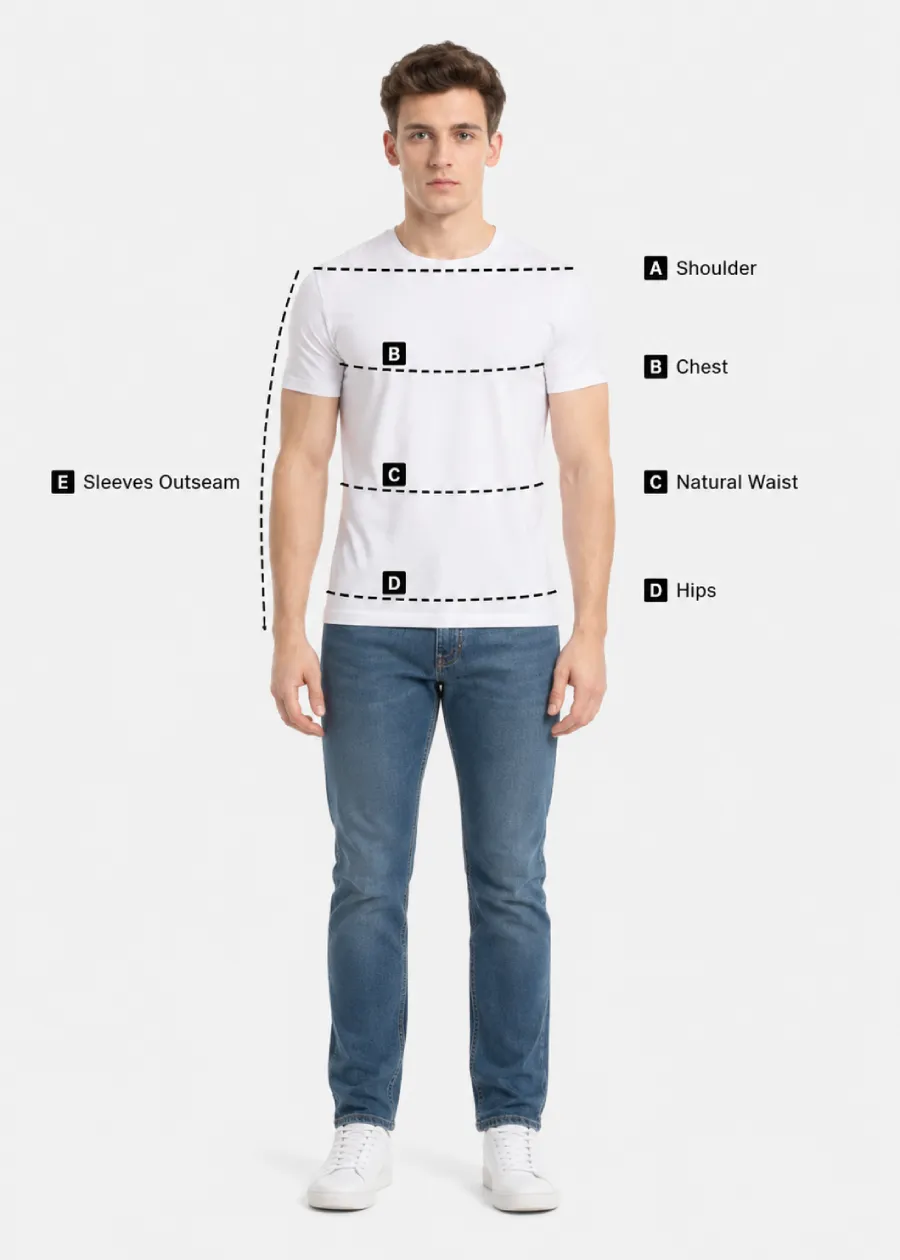
Use a soft measuring tape and keep it level without pulling it tight. Measure the chest around the fullest part with the tape passing under the arms, and the sleeve from the shoulder point down to the wrist with the arm relaxed at your side.
This site is registered on wpml.org as a development site. Switch to a production site key to remove this banner.
Reviews
There are no reviews yet.